
Think about everything that goes into keeping a supply chain running at peak performance. Data is constantly moving between systems, decisions are being made in real time, and operations teams are balancing speed, cost, and service at every turn. When that flow breaks down, performance suffers. That is exactly why applying AI across warehouse and transportation operations matters today. It has the potential to connect data, enhance decision making, and bring greater alignment between strategy and execution across the entire 3PL network.
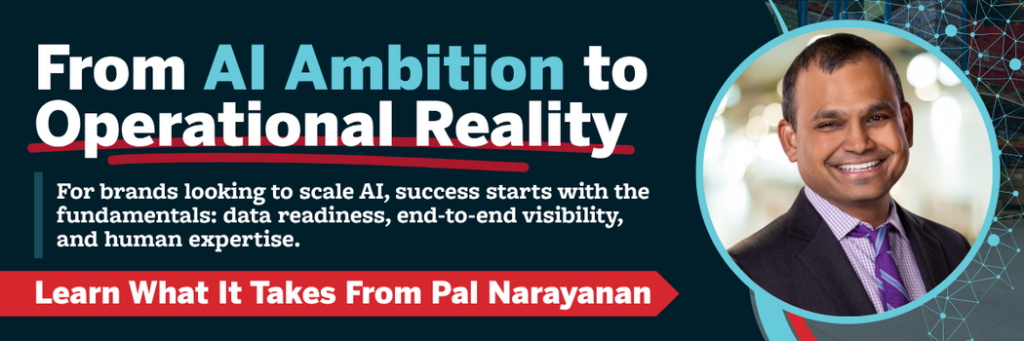
We sat down with Pal Narayanan, Chief Digital and Information Officer at Kenco, for a Q&A on using AI to accelerate supply chain performance from a 3PL perspective, where strategy meets execution. He shares how AI is driving smarter decision making across warehouse and transportation operations, the realities of adoption at scale, and where organizations are seeing the greatest impact today.
QUESTION: Pal, from a 3PL lens where strategy meets execution, where is AI really making an impact across warehouse and logistics operations today?
Pal: AI is improving warehouse and logistics operations by automating routine tasks and enhancing visibility, planning, and execution. It supports week-ahead and month-ahead forecasting to better predict volumes, inventory, and labor needs. In transportation and brokerage, it helps optimize bidding to improve win rates while maintaining margins.
Real-time insights are now more accessible through chat-based tools and dashboards, enabling faster, data-driven decisions. AI also powers task execution through intelligent agents that handle activities like wave planning and allocation, allowing teams to focus on exceptions and higher-value work.
QUESTION: Brands often design AI-driven strategies, but execution happens in your world. Where do those strategies typically break down once they hit the warehouse or transportation network?
Pal: AI adoption in warehouse and logistics operations is often limited by poor data quality, limited visibility, and missing business context. Without clean, structured data and strong pipelines, AI struggles to deliver reliable results. Gaps in end-to-end visibility across shipments, inventory, and volumes further weaken execution and decision-making.
Another key challenge is the lack of operational context, such as promotions or marketing plans. Because of this, AI works best as a tool that supports human judgment, helping teams make more informed, real-time decisions rather than fully replacing them.
QUESTION: What’s the hardest part about scaling AI across a logistics network, especially across multiple customers, sites, and systems?
Pal: AI implementation in warehouse and logistics operations is often slowed by complex IT environments, data challenges, and resistance to change. It is not one size fits all and must be tailored to each site and workflow.
Scaling adds complexity, as solutions must work across different facilities and systems. Data inconsistencies and integration gaps make this harder, so success depends on strong alignment across data, systems, and teams.
QUESTION: Are you seeing customers push for AI capabilities that aren’t operationally realistic yet?
Pal: Unrealistic expectations and a limited understanding of AI capabilities often slow adoption. Many overestimate what generative AI can deliver today, which can lead to trust issues when results fall short or produce inconsistent outputs.
AI still requires human oversight and is most effective as an enabler, not a fully autonomous solution. The strongest implementations take a hybrid approach, combining AI, traditional software, and a solid data foundation. Without these in place, scaling becomes difficult. Success comes from aligning expectations and embedding AI into workflows where it supports better, more informed decision making.
QUESTION: Where do expectations outpace what’s possible?
Pal: A common challenge in deploying AI is the gap between expectations and reality. Customers may not fully understand what AI can deliver, leading to misalignment when results are less immediate or precise than expected.
Forecasting highlights this clearly. While AI can improve predictions, it cannot account for every sudden demand shift or external change. When this is not understood, expectations can become unrealistic. Bridging the gap requires clear communication on AI capabilities and positioning it as a tool that supports decision.