
Summary: Why do successful companies miss their next growth opportunity? In a column for Inc., Kenco President and CEO Denis Reilly argues that strong results breed comfort with the current playbook, so leaders wait for a crisis to change. His advice: watch for early warning signs, start the next growth curve while momentum is high, and let today’s business fund tomorrow’s.
In a new column for Inc., Denis Reilly makes a case that sounds backward at first. A company’s success, he says, can be the very thing that hides its next opportunity. When revenue is growing and customers are loyal, change feels unnecessary. Reilly says the hardest part of a CEO’s job is building urgency for change while the business still looks strong. Read Denis Reilly’s full article on Inc.
The warning signs hide inside good results
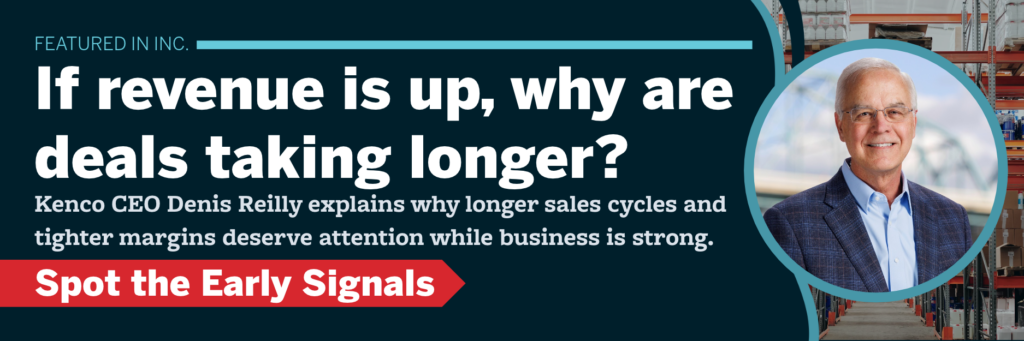
Reilly notes that turning points rarely arrive as a crisis. They show up as small signals that are easy to dismiss when the numbers look good. Examples include slower sales cycles, margin pressure despite growth, and customers asking for capabilities the company wasn’t built to provide. Spotting these early gives leaders time to plan their next move while they still have momentum.
Start the next S-curve before this one flattens
Reilly uses the business S-curve to explain what happens next. Companies build slowly, accelerate as the model takes hold, and then mature, when each gain takes more effort than the last. His key point is that the mistake is waiting for growth to flatten before looking for what comes next. He adds that each phase of growth may call for a different style of leadership.
Why leaders wait too long
According to Reilly, the hard part is human. Leaders grow attached to the model that built the company. Organizations reward execution over exploration, and confidence slowly turns into comfort. By the time a crisis forces change, the window to act has often narrowed.
Three questions Reilly says every CEO should ask
- Is growth getting harder? Look past revenue to see whether each new result takes more effort than the last.
- What are customers asking for that we can’t deliver? Patterns in customer requests often reveal the next opportunity before strategy sessions do.
- If we started the company today, what would we do differently? This separates the strengths worth keeping from habits that are just history.
Protect the core while building what’s next
Reilly says the current business and the future business aren’t competing priorities. In his words, “The current business funds the future business.” The goal is to have the next growth curve taking shape before today’s growth slows.
Read the full article: For Reilly’s complete framework, read Why Successful Companies Miss Their Next Growth Opportunity on Inc.
Frequently asked questions
Why do successful companies miss their next growth opportunity? Denis Reilly says success creates comfort with the current playbook. Leaders become attached to what worked and organizations reward execution over exploration. As a result, many wait for a crisis before they change.
What are early signs a business is reaching an inflection point? Reilly points to slower sales cycles, margin pressure despite growth, customer requests the current model can’t meet, and a competitive edge that is harder to explain.
What is the business S-curve? It is a growth pattern in which a business builds slowly, accelerates, and then matures as each result takes more effort. Reilly advises starting the next curve before the current one flattens.
What questions should CEOs ask to find their next growth curve? Reilly recommends three: Is growth getting harder? What are customers asking for that we can’t deliver? If we started today, what would we do differently?