
What if safety teams could spot more risk before it turned into harm?
Not just after an incident. Not once a report is filed. Not only when someone happens to notice a pattern.
But earlier: in the movement, the conditions, the behaviors, and the signals that often appear before something goes wrong.
This is where Kenco’s safety journey has been heading for years: toward a more proactive, people-centered approach built on engagement, ownership, and learning.
Today, AI is helping strengthen that approach by giving teams better visibility into emerging risks and more opportunities to act before harm occurs.
Where Kenco is using AI for safety today
As Kenco’s safety journey has evolved over the years, so has the role of technology in supporting it.
Today, we use AI in three important ways: to spot risk sooner, strengthen safety insight, and support more proactive intervention.
Spotting unsafe conditions and emerging risks sooner
One important way Kenco is using AI is to improve visibility into unsafe conditions and emerging risk patterns across the operation. In dynamic environments, risk is not always obvious in the moment. It can build through repeated behaviors that are easy to overlook when teams are relying on manual observation or after-the-fact reporting alone.
The truth is, safety teams cannot be everywhere at once.
Many early warning signs never make it into a formal report, near misses are often underreported, and patterns take time to surface. By the time an issue becomes visible, it may be too late to intervene.
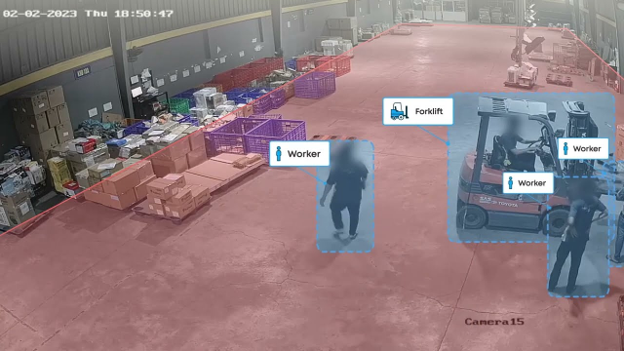
But AI-enabled computer vision helps close that gap by continuously analyzing activity from existing camera environments and surfacing potential risks earlier. Instead of waiting for an incident review to uncover what happened, our safety teams can gain more immediate visibility into unsafe events and emerging patterns so we can act sooner, investigate faster, and make more proactive safety decisions.
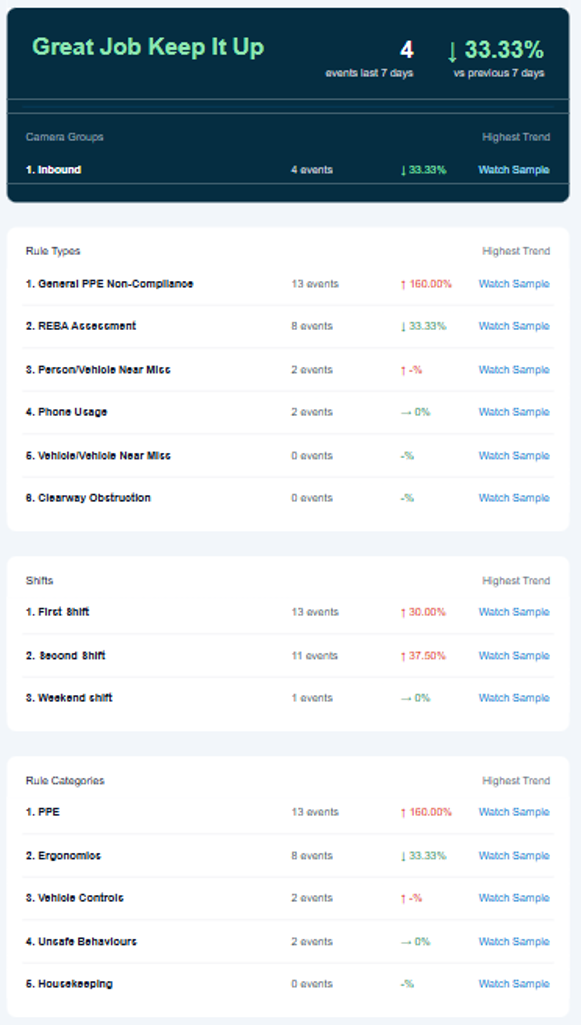
A weekly dashboard also keeps everyone aware of and accountable for at-risk behaviors, and shows the team how overall performance is trending.
Strengthening safety insight with better data and faster follow-through
Another important way Kenco is using AI is to improve the quality, speed, and usefulness of safety data. Strong safety performance depends on more than identifying risk in the field. It also depends on capturing what happened clearly, documenting it consistently, and turning that information into action quickly enough to make a difference.
Unfortunately, that’s where many safety workflows break down. Reports are often incomplete, inconsistent, or delayed. Important details can get buried in long narratives, photos, forms, or attachments. Teams often spend too much time tracking down information, re-entering data, or trying to piece together what happened instead of analyzing patterns and acting on what they learn.
That’s why we’ve turned to AI embedded in our EHS software to help streamline that work. Out of the box, these capabilities can summarize lengthy documents, interpret image content, analyze forms and dashboards for trends and anomalies, and surface prioritized next steps. They can also help users write clearer, more accurate reports for incidents, audits, inspections, concerns, good catches, and corrective actions.
AI is also helping streamline workflows that are often manual and time-consuming. For example, voice and photo-assisted concern reporting can turn spoken observations and images into structured reports, while AI-assisted checklist authoring can extract questions from existing documents and speed up setup. Suggestion tools can draft corrective actions and compliance task plans, helping our teams move more quickly from issue identification to response.
For Kenco, this means better safety intelligence with less administrative burden. When teams can capture richer detail, summarize information faster, and surface insights more easily, they are better equipped to identify trends, prioritize action, and follow through. In that way, AI is not just improving reporting efficiency. It is helping strengthen the quality of learning and decision-making that proactive safety depends on.
Seeing ergonomic risk before it becomes injury
Kenco is also using AI to take a more proactive approach to ergonomic risk — one of the most persistent and often overlooked sources of workplace injury. Unlike a single incident, ergonomic strain usually builds over time through repeated motion, awkward posture, overreaching, or the way a task is performed day after day.
Powered by video-based assessment, these tools act like a “digital ergonomics expert” that can spot risky movements, predict injuries, and recommend improvements by simply watching and analyzing a short video captured on a phone camera. It then builds an assessment tied to recognized methods like REBA and NIOSH.
However, the value goes beyond individual assessments. Kenco can also use these insights to spot musculoskeletal risk patterns across the business, identify higher-risk areas, and analyze ergonomic risk trends over time. That creates a more scalable way to understand whether interventions are working and where additional changes in process, workstation design, or coaching may be needed.
For Kenco, this creates the opportunity to approach ergonomics with more consistency, visibility, and precision. Instead of relying only on periodic review or reactive response after an injury occurs, teams can use AI-supported insight to better understand movement-related risk and take action sooner.
Smarter tools + stronger culture = safer people
Creating the safest possible environment requires our people having better visibility, better insight, and better tools to protect one another. At Kenco, AI is helping make that possible, turning our safety commitment into daily action and impact across the operation.