
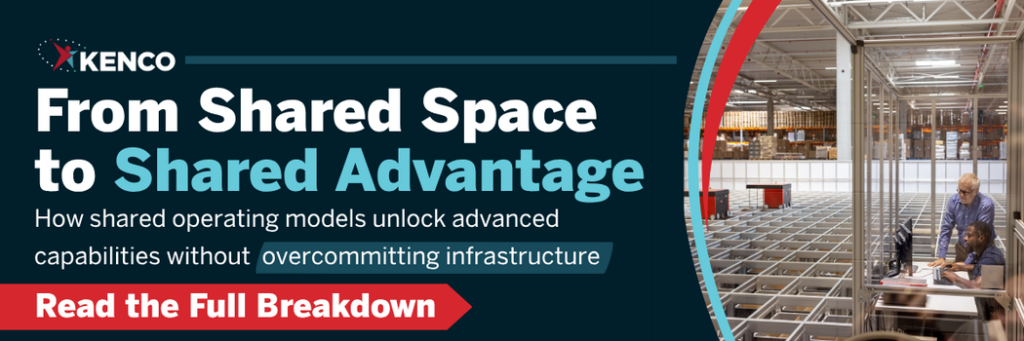
For years, multi-client warehousing was seen as a flexibility and cost efficiency play — a way to stay nimble, avoid the fixed overhead of a dedicated warehouse facility, and scale capacity as needed.
All of that still matters, but it’s not the full story.
Today, the strongest multi-client environments do more than share square footage.
They give companies a faster path to capabilities that can improve service, scale, and competitiveness with access to technology, infrastructure, and operational capabilities that can be harder to justify in a dedicated warehousing model.
In a standalone setup, those investments often come with hefty capital requirements, implementation complexity, and long payback periods. For mid-sized brands, seasonal businesses, and companies testing new markets, that can make these advanced capabilities feel out of reach.
Where multi-client warehousing changes the equation
Instead of every company having to ask, “Can we make this investment work on our own?” the question becomes, “Is there a smarter way to access these technologies and capabilities?”
Multi-client warehousing offers a shared operating model that spreads cost, risk, and utilization across multiple customers. This in turn opens the door to new systems and infrastructure for all.
Why shared access can actually be an advantage
When technologies like robots or advanced material handling are used in a shared environment, they see steadier, more consistent utilization. This means more opportunities to fine-tune workflows, learn faster from diverse customers, and execute more consistently.
All of this to say, you can get more value from the system over time. Innovation and continuous improvement becomes embedded in daily operations (instead of sitting on a product roadmap).
This is where the real mindset shift happens. In the right environment, multi-client space stops looking like a concession andstarts looking like a competitive advantage — allowing companies to modernize faster, achieve better service levels and more scalable fulfillment, and the ability to grow without overcommitting infrastructure.
In other words, the benefit is not just that the technology is available. It is that companies can step into a more mature operating environment from day one.
Technologies built to scale in shared environments
Some technologies are especially well suited to a multi-client model, like:
- Automated storage and retrieval systems (AS/RS), like AutoStore
- Robotics and goods-to-person systems
- Advanced material handling equipment
- Warehouse management systems and analytics
- Integrated transportation and fulfillment technology
What these capabilities have in common is that they deliver the most value when they are used consistently, at scale, and as part of a well-run operating environment.
Who benefits most from multi-client warehousing
A multi-client setup tends to make the most sense for companies that need more operational sophistication, but are not ready to build around it alone. That often includes:
- Mid-sized brands
- Fast-growing businesses
- Companies with seasonal swings
- Teams expanding into new channels or markets
These organizations may have enough complexity to benefit from advanced systems, but not always the steady volume, long-term certainty, or appetite for investment that a dedicated model requires.
What the right partner should bring
If a shared model feels like the right fit, the next question is who you trust to run it well. The right partner brings more than just the space itself and technology. They know how to run these advanced environments well across different customer needs, connect warehousing with transportation and MHE, and keep improving the operation over time.
Most importantly, they have the right mindset — treating innovation as an operating capability, not a one-time install.
How Kenco turns shared space into shared advantage
Kenco’s Jeffersonville facility shows what this looks like in practice: a shared environment where customers of all sizes can tap into advanced automation and compete with the fulfillment capabilities of much larger operations.
Kenco’s AutoStore installation there includes 49,000 bins, 130 robots, 10 picking ports, and four replenishment ports. With an expected throughput of 15 million units per year, the Jeffersonville facility opens the door to technologies and operating models that help companies modernize sooner, learn faster, and stay more adaptable as needs change.
But the bigger story is not just about the equipment itself — it’s the operating model around it. At Kenco, technology is part of an integrated logistics system, combining warehousing with eCommerce technology, analytics, parcel optimization, MHE support, and automation guidance. In other words, the value is not just access to a more advanced facility, but to the systems, expertise, and operational support that help the whole operation run better.